
HVAC flat-rate pricing: build a price book
November 19, 2026

HVAC flat-rate pricing starts with your labor burden, not with the number a competitor charges. A flat-rate price book is a list of the jobs you sell and the price you charge for each one. The prices come from your own costs.
Most books are built once and then edited without checking the costs. A part goes up, nobody updates the line, and the price slowly stops covering the cost. The customer never sees the book, though. The customer sees a quote. If the quote is retyped for every job, the price in the book and the price on the quote stop matching, and the quote is the one that gets paid.
Start with labor burden, not the hourly rate
A tech paid $30 an hour costs more than $30. Payroll taxes, workers' compensation, health and retirement contributions, paid time off and training are all on top, and some paid hours are never billed.
Two steps turn a wage into a loaded cost, which is what an hour of work really costs you:
Burden. Add the employer costs. If they add 35%, $30 becomes $40.50 an hour.
Billable share. If 75% of paid hours are billable, divide $40.50 by 0.75. The loaded cost is $54 per billable hour.
Use $54 as the labor cost of every task. If you use the wage instead, every price in the book is too low, and each one still looks reasonable on its own.
These figures are an example, not a benchmark. Your burden, billable share and market will change every number.
Add overhead, the truck and a callback reserve
Overhead is what the business pays whether or not a van goes out: rent, office staff, software, insurance, marketing, vehicle payments, tools, permits and utilities. You can add it as a percentage of direct cost or as a cost per billable hour. Pick one method and use it everywhere. Mixing the two hides costs you have already counted.
Count the truck once. If your overhead percentage already includes vehicle payments, do not add truck cost again; if it does not, give the truck its own line. A truck that costs $18,000 a year and produces 1,500 billable hours costs $12 an hour before a single part goes on the ticket.
Set aside money for callbacks and warranty. Some visits have to be redone for free. Decide what percentage of revenue covers that, and add it to the price, so every job pays a small share instead of one bad week paying for all of it.
Margin and markup are different numbers
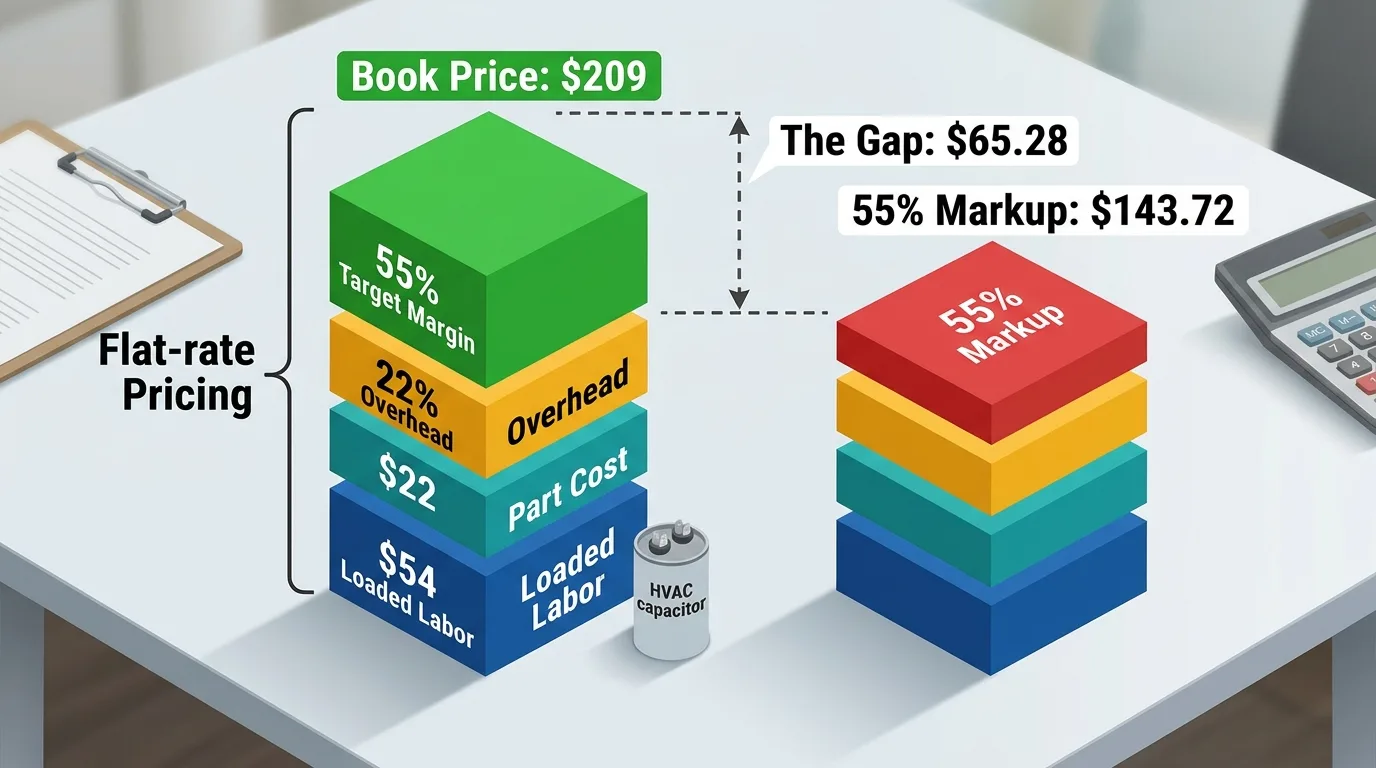
Margin is the share of the price you keep after costs. Markup is the percentage you add to cost. A 55% markup is not a 55% margin, and the formula below uses margin.
Price = ((labor hours × loaded labor cost) + part cost) × (1 + overhead %) ÷ (1 − target margin)
Here it is on a dual run capacitor:
1.0 hour × $54 loaded labor = $54
part cost $22, from a supplier invoice with a date on it
direct cost $76
overhead at 22%: $76 × 1.22 = $92.72
target margin 55%: $92.72 ÷ (1 − 0.55) = $206
book price: $209
If you multiply $92.72 by 1.55 instead of dividing it by 0.45, you get $143.72. That is a 55% markup, but the margin is only 35.5%. On this job the difference is about $65, and the same mistake repeats on every ticket priced that way.
The 55% is only an example. Choose your own target margin and use it on every line. On parts-heavy jobs, check the result against local prices and set a minimum, so one expensive part does not pull the whole job down to break-even.
Build the book in three passes
1. Diagnostic or trip charge
Price the visit so it covers the drive, the diagnosis and a written repair option. Decide before you publish whether the fee is credited against the repair, and write the rule down. If the visit is free, it is a discount, so treat it like one.
2. Repeat repairs
Open last year's tickets and list the twenty or thirty jobs you do most. For each one, write down the labor hours including drive and setup, the part cost and the date you checked it, and the price from the formula. The examples below use the capacitor assumptions. The numbers are illustrations, not a price guide.
Diagnostic visit: 0.75 hour, no part, $110
Dual run capacitor: 1.0 hour, $22 part, $209
Contactor: 1.0 hour, $28 part, $225
Condenser fan motor: 1.5 hours, $145 part, $615
ECM blower motor: 2.0 hours, $310 part, $1,135
3. Changeouts
Changeouts, where you replace a whole system, vary too much for one price. Build three options from costed scopes: equipment, line set, thermostat, permit, labor days, disposal and warranty. The options should differ in what gets installed, not in how much margin you give up.
Save the three options, the terms and the notes once as a quote template, so the next changeout starts from a finished quote instead of a blank page.
Quote it two ways

In JoQuote, a repair is quoted from price book items. The tech picks the item, sets the quantity and sends the quote. The price comes from the book, so nobody types it from memory.
A changeout is a repeatable job with a known structure. Start from the saved quote template, pick the customer, change the numbers that are different, add or remove items, and send. The items, the three options and the terms are already there.
Both ways end in the same place. Each send is saved as a version: a fixed copy of the quote with its own total. The customer accepts one version, and that version becomes the job. The deposit is taken against it, and the invoice is raised from it instead of being typed again.
If someone changes a price, the change makes a new version with a new total. The old version and its total stay on record. That is what stops the quote in the truck from being different from the quote in the inbox.
After the customer says yes
In JoQuote the job goes on the schedule with a tech who has the right skills and is not on approved leave. The deposit and the invoice stay on the same record, and the payment is recorded against it. Invoices and payments can then sync to QuickBooks Online or Xero.
The schedule shows the whole week, one column per crew member, with approved leave on the same calendar. The accounting integration means the month-end does not start with retyping invoices.
Tune-ups and maintenance visits
A tune-up has its own labor time, parts allowance, drive and season. Price it with the same formula instead of copying last year's price. Write down what is included, and price any repair found during the visit from the repair book rather than making up a number at the door.
The visit is also a good template: the same items and terms, adjusted when the site or the scope changes.
Publish the book
Give it an effective date. Give every tech the same copy. Decide who can change a price, by how much, and who has to approve it first.
Explain the math once, in a team meeting. Most techs lower prices because they want to be helpful, not because they disagree with margin. Show them the capacitor: the part cost, the labor cost, and why the price is $209 and not the $143.72 a 55% markup produces.
When a customer says a competitor is cheaper, offer a different option instead of a discount: a smaller scope, a lower option, a later date. Review the first month of quotes. If the book is wrong, fix the hours, the part cost or the overhead. Do not take it out of the margin.
What goes wrong with a price book
Rounding down. A $209 price becomes $199 at the door because round numbers feel friendlier. That is a margin cut made by habit.
Small discounts that become normal. One tech gives a repeat customer a break, another matches a competitor, and three months later the book is only a starting point. A discount entered on a quote makes a new version that can be seen later. A discount given verbally leaves no record.
Tax. Parts and labor are taxed differently depending on where you work. Check the rule with your accountant and make sure the quote and the invoice use the same treatment.
Part costs with no date. A cost from three years ago gives you a three-year-old price with today's expenses behind it.
Refrigerant with no date. Since the 2023 Technology Transitions Rule, new residential and light-commercial equipment has been moving to refrigerants with a global warming potential below 700, mostly R-454B and R-32. The installed base still runs on R-410A, which has a GWP of about 2,088 against about 466 for R-454B. Compliance dates have changed since the rule was finalized, so check the EPA's current guidance. For the book, keep two service lines: R-410A and R-454B/R-32, each with its own supplier, cost and checked date. Do not quote a refrigerant price from memory.
No owner. A book nobody owns is a book nobody updates. Name the person, and put the review date in the calendar.
Price the next job from the book
You do not need a perfect book on day one. Build the twenty jobs you sell most, put a date on every cost, and quote from it for a month. Then fix what the quotes and the tickets tell you.
Plan details are on the pricing page.
See the quote flow and use the book on the next job.
Frequently asked questions
How often should we update the price book?
Review every line once a year, and update a line as soon as a supplier invoice shows a new price. Refrigerant, motors and equipment can move several times in a year. The date on the cost is what tells you whether the price is still true.
Should the diagnostic fee be credited against the repair?
It is a policy choice, not a pricing formula. Price the visit so it covers the drive and the diagnosis on its own, then decide whether to credit it. If you credit it, make it a written rule so every tech applies it the same way.
Should we quote from price book items or from a template?
Both, for different jobs. A one-off repair is a few price book items. A repeat job with a known structure, such as a changeout or a standard maintenance visit, is faster from a saved template that already carries the items and terms. The template is a starting point; the numbers still get checked against the customer and the site.
What do we do when refrigerant prices move?
Keep the refrigerant on its own line with a supplier and a checked date, and reprice when the invoice changes. Do not quote a refrigerant price from memory, and do not bury it in a generic materials line where nobody can see it move.
Can one book serve every market we work in?
Usually not. Labor burden, overhead, permits and supplier costs differ by market. Keep a book per branch, or a base book with a market adjustment that you review against real costs, not a multiplier someone set once.